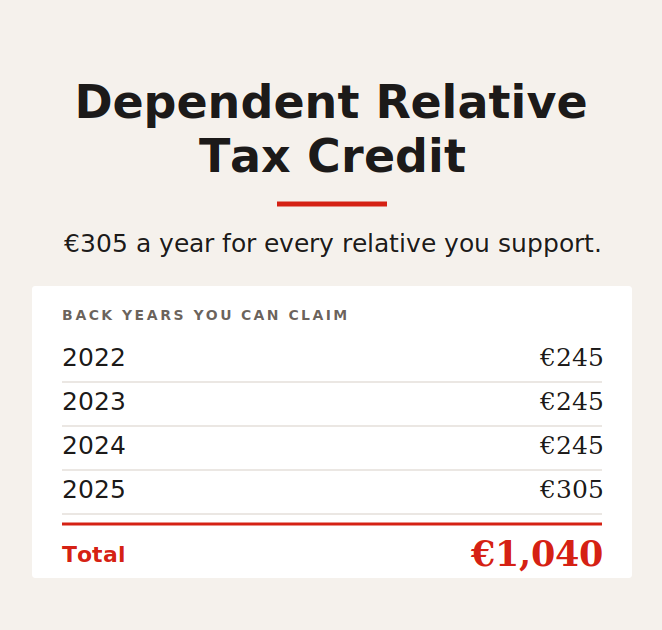
The Dependent Relative Tax Credit is worth €305 in 2026. You can claim it if you support an elderly relative at your own expense who cannot support themselves — and if you’ve never claimed it, you can go back four years, worth up to €1,040 per relative.
The credit is refused for any year in which your relative’s own income was above the limit for that year (€18,548 in 2026). Most people who qualify have never heard of it.
Written by the Irish Tax Rebates team. Last reviewed: 12/08/2026. Figures verified against Revenue guidance current at that date.
What is the Dependent Relative Tax Credit?
The Dependent Relative Tax Credit reduces the income tax you pay if you are substantially maintaining a relative at your own expense — typically an elderly parent, or a relative who cannot look after themselves because of age or infirmity.
It is a tax credit rather than a relief, which means it comes straight off your tax bill euro for euro, not off your taxable income.
It’s set out in section 466 of the Taxes Consolidation Act 1997, and you’ll sometimes see it written as the “Dependant Relative Tax Credit” or shortened to DRR.
How much is the Dependent Relative Tax Credit worth?
€305 per qualifying relative for 2026. The credit rose from €245 to €305 with effect from 1 January 2025, and held at €305 for 2026.
There is no cap on how many relatives you can claim for, provided each one independently meets the conditions and you are genuinely maintaining each of them at your own expense.
Credit value and income limit by year
Work out what you could be owed
Tick each year you supported a qualifying relative and their income was under that year’s limit.
Number of qualifying relatives:
Estimated refund: €0
Estimate only, based on the Dependent Relative Tax Credit alone. Your actual refund depends on the tax you paid in each year and on any other credits you’re due.
The income test applies to your relative’s income, not yours. Your own earnings are irrelevant to this credit.
How much can you claim for past years?
Tax refund claims in Ireland are limited to four years under section 865 of the Taxes Consolidation Act 1997. So a claim made during 2026 can reach back to 2022.
Each year is tested separately. If your relative’s income crept above the limit in one year, that year drops out and the others still stand. Here’s what the back years are worth:
| Tax year | Credit value per relative |
|---|---|
| 2022 | €245 |
| 2023 | €245 |
| 2024 | €245 |
| 2025 | €305 |
| 2026 | €305 |
The 2026 credit of €305 is the current year’s credit, claimed going forward on your tax credits rather than as a back-claim.
The four-year rule is a hard deadline. Once 31 December passes, the oldest year is gone permanently. Every year, people miss out on money they were entitled to simply because they didn’t know the credit existed.
Who can claim the Dependent Relative Tax Credit?
You can claim if you maintain, at your own expense, a relative of yours or of your spouse or civil partner who is any of the following:
- A relative who is unable to maintain themselves because of old age or infirmity
- Your widowed mother or father — incapacitated or not
- A parent who is a surviving civil partner — incapacitated or not
- Your own child, if they live with you and you depend on their care because of your own old age or infirmity
Your relative does not have to live in Ireland. If you’re sending money home to a parent abroad, the credit is still available. The one exception is the last category above — a child on whose services you depend must live in Ireland with you.
“Relative” is read broadly here: a parent, grandparent, brother, sister, aunt or uncle can all qualify if the conditions are met. And note that the credit is not generally available for your own child unless that child is your carer and lives with you.
What does “maintaining at your own expense” mean?
It means meeting the costs of everyday living — not the occasional gift or a hand with a bill. Revenue expects you to be able to demonstrate genuine, substantial support: standing orders, regular bank transfers, direct payment of their rent, utilities, groceries or care costs.
Keep the evidence. If you’re claiming for an incapacitated relative, you also need to be able to show that the incapacity prevents them from maintaining themselves.
What income counts towards your relative’s limit?
All of it. The income limit takes in their State pension and any other social welfare payments, occupational or private pensions, deposit interest, rental income and earnings. This is the single most common reason a claim fails — a relative on a full contributory pension plus a small private pension can be over the line without either of you realising.
What if more than one of you supports them?
Where two or more people maintain the same dependent relative — three siblings sharing the cost of supporting a parent, say — the credit is divided between them rather than each claiming the full amount. It’s worth agreeing between yourselves before anyone claims.
Other credits worth checking at the same time
Households claiming this credit very often qualify for others they’ve never claimed either. Before you file, it’s worth checking:
- Home Carer Tax Credit — for jointly assessed couples where one partner cares for a dependent person at home
- Tax relief for employing a carer — relief at your marginal rate on the cost of employing a carer
- Incapacitated Child Tax Credit and the Blind Person’s Tax Credit
- Medical expenses relief — you can claim relief on health expenses you pay for your relative, as well as your own
- Aggregation Relief — if your spouse or civil partner lives abroad
You can also claim medical insurance relief on premiums you pay for your relative, and mortgage interest relief where you pay the interest on a loan providing your relative with their main home.
How to claim the Dependent Relative Tax Credit
There are two routes.
Do it yourself through Revenue. Sign into myAccount, and for the current year go to PAYE Services → “Manage your tax for the current year” → “Claim tax credits” → “You and your family” → Dependent Relative Tax Credit. For past years, use “Review your tax for the previous 4 years”, request a Statement of Liability, and complete an Income Tax Return for each year. Revenue also publishes Form DR1 (and Form DR2 where you’re claiming for a child on whose services you depend).
Or let us do it. If you’re a PAYE taxpayer, we’ll review all four years, claim this credit and every other credit you’re entitled to, and handle Revenue on your behalf. We need very little from you: your relative’s name and date of birth, and your relationship to them.
No rebate, no fee. If we don’t get you money back, you don’t pay us. We’ve been doing this since 2002 for more than 250,000 clients across Ireland.
New customers: apply in 60 seconds →
Already a client? Apply for an additional rebate.
Dependent Relative Tax Credit: frequently asked questions
How much is the Dependent Relative Tax Credit in 2026?
€305 per qualifying relative. It was €305 in 2025 and €245 for 2022, 2023 and 2024.
Does my relative have to live in Ireland?
No. The relative can live anywhere, provided you are maintaining them at your own expense and they meet the other conditions. The only exception is a claim for a child on whose services you depend — that child must live in Ireland with you.
Can I claim for my mother if she has the State pension?
Possibly. The State pension counts towards her income limit along with everything else she receives, so it depends on her total income for the year. In 2026 she must be under €18,548. A relative on the State contributory pension alone is usually under the limit; add a private or occupational pension and it’s worth doing the sum year by year.
Can two people claim for the same relative?
Not in full. Where more than one person maintains the same relative, the credit is divided between them.
How far back can I claim?
Four years. A claim made in 2026 covers 2022 to 2025, worth up to €1,040 per relative. Once the year ends, the oldest year drops out of reach for good.
Is this the same as the Home Carer Tax Credit?
No — they’re separate credits with separate conditions, and you may be entitled to both. The Home Carer Tax Credit applies to jointly assessed couples where one partner cares for a dependent person in the home. The Dependent Relative Tax Credit applies where you financially maintain a relative who cannot maintain themselves, whether or not they live with you.
What proof do I need?
Evidence that you are substantially maintaining your relative — bank transfers, standing orders, or direct payment of their living costs. Where the claim rests on incapacity, you also need to be able to show the relative is unable to maintain themselves because of old age or infirmity. Keep records for six years.